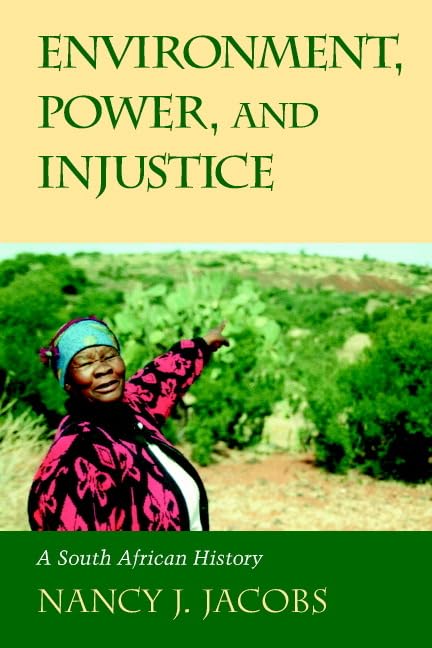
Environment, Power, and Injustice a South African History Nancy J Jacobs
Material type: TextSeries: Environment, Power, and Injustice ; 9780521 010702Publication details: Cambridge: Cambridge University Press, 2003. Description: xxi, 293 pages colour illustrations: maps 24 cmISBN: 9780521 010702Subject(s): South AfricaDDC classification: 306.3490968 JACO Summary: Summary: This book presents the socio-environmental history of the black people in the area near Kuruman, on the edge of the Kalahari in South Africa. Considering successive periods - Tswana agropastoral chiefdoms before colonial contact, the Cape frontier, British colonial rule, Apartheid, and the homeland of Bophuthatswana in the 1980s - Environment, Power, and Injustice shows how the human relationship with the environment corresponded to differences of class, gender, and race. While exploring biological, geological, and climatology forces in history, this book argues that the challenges of existence in a semidesert arose more from human injustice than from deficiencies in the natural environment. In fact, powerful people drew strength from and exercised their power over others through the environment. At the same time, the natural world provided marginal peoples with some relief from human injustice.
| Item type | Current library | Collection | Shelving location | Call number | Status | Date due | Barcode |
|---|---|---|---|---|---|---|---|
 Series
|
Mkhuhlu | 300: Social Science | Non Fiction | 306.3490968 JACO (Browse shelf(Opens below)) | Available | 33228 022947921 |
monograph
Not Included
Summary: This book presents the socio-environmental history of the black people in the area near Kuruman, on the edge of the Kalahari in South Africa. Considering successive periods - Tswana agropastoral chiefdoms before colonial contact, the Cape frontier, British colonial rule, Apartheid, and the homeland of Bophuthatswana in the 1980s - Environment, Power, and Injustice shows how the human relationship with the environment corresponded to differences of class, gender, and race. While exploring biological, geological, and climatology forces in history, this book argues that the challenges of existence in a semidesert arose more from human injustice than from deficiencies in the natural environment. In fact, powerful people drew strength from and exercised their power over others through the environment. At the same time, the natural world provided marginal peoples with some relief from human injustice.
Adult
There are no comments on this title.