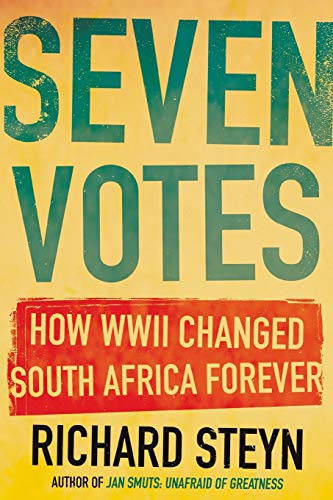
Seven votes, how WW11 changed South Africa forever. Richard Steyn.
Material type: TextPublication details: Johannesburg; Jonathan Ball Publishers; 2020. Description: 327 pages 23 cmISBN: 9781776190355DDC classification: 940.5368 STEY
| Item type | Current library | Collection | Shelving location | Call number | Status | Date due | Barcode |
|---|---|---|---|---|---|---|---|
 Book
Book
|
Amersfoort Library
Amersfoort library its open from Monday to Friday from 07:45 to 16h30, lunch time 13h00 to 13h45. We have free access to internet Library is close on weekends Library users is required to follow Covid 19 rules
|
900: History & Geography | Non Fiction | 940.5368 STEY (Browse shelf(Opens below)) | Available | 3322803186454 | |
|
Book
|
DAGGAKRAAL PUBLIC LIBRARY
wearing of mask is compulsory when visiting the library, all Covid-19 protocols should be adhered to. Library operating hours are: Mon- Fri (07h45-16h30) Sat-Sun (Closed)- Public Holidays
|
900: History & Geography | Non Fiction | 940.5368 STEY (Browse shelf(Opens below)) | Available | 3322803186455 |
If a mere seven more MPs had voted with Prime Minister JBM Hertzog in favour of neutrality, South Africa’s history would have been quite different. Parliament’s narrow decision to go to war in 1939 led to a seismic upheaval throughout the 1940s: black people streamed in their thousands from rural areas to the cities in search of jobs; volunteers of all races answered the call to go ‘up north’ to fight; and opponents of the Smuts government actively hindered the war effort by attacking soldiers and committing acts of sabotage. World War Two upended South Africa’s politics, ruining attempts to forge white unity and galvanising opposition to segregation among African, Indian and coloured communities. It also sparked debates among nationalists, socialists, liberals and communists such as the country had never previously experienced.
As Richard Steyn recounts so compellingly in 7 Votes, the war’s unforeseen consequence was the boost it gave to nationalism, both Afrikaner and African, that went on to transform the country in the second half of the 20th century. The book brings to life an extraordinary cast of characters, including wartime leader Jan Smuts, DF Malan and his National Party colleagues, African nationalists from Anton Lembede and AB Xuma to Walter Sisulu and Nelson Mandela, the influential Indian activists Yusuf Dadoo and Monty Naicker, and many others.
There are no comments on this title.