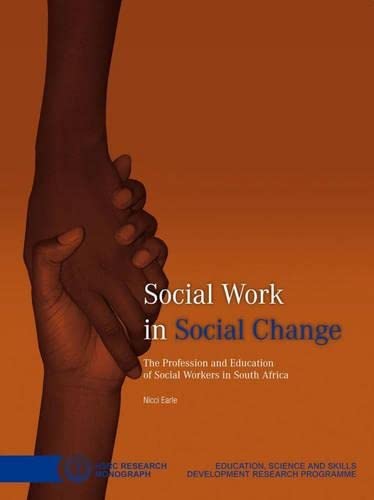
Social work in social chang The profession and education of social workers in South Africa Nicci Earle.
Material type: TextSpoken language: English Series: HSRC research monograph HSRC research monograph ; 9780796 922083Publication details: Cape Town: HSRC Press, 2008. Description: xii, 163 pages: Colour illustrations: 29 cmISBN: 9780796 922083Subject(s): -- Social services, Social service vacational, Social work education | -- South Africa | South Africa | | DDC classification: 361.30711 EARL Summary:
This study forms part of a series of studies on professions and professional education being conducted by the HSRC's research programme on Education, Science & Skills Development. It follows a pilot study on medical doctors, published in 2006 entitled Doctors in a Divided Society: The profession and education of medical practitioners in South Africa. Like the other studies in the series, this study involved developing an understanding of the professional milieu and professional labour market of social workers. As the implementers of government social policy, social work professionals have been at the forefront of grappling with the practicalities of the changes in focus, approach and methods of social security and social service delivery since 1994. It examines developments in the education and training of social workers within the democratic dispensation, the most significant of which is the development of a national, standardised Bachelor of Social Work degree. The study also reveals that the dominant profile in student enrolment and graduation statistics has changed from white female to African female, and that enrolment has increased significantly. However, the study also shows that graduation trends have been negative and losses due to emigration are an additional concern. Given the scarcity of these professionals against the demand for their services, understanding the factors that contribute to this picture are critical to effective intervention.
TextSpoken language: English Series: HSRC research monograph HSRC research monograph ; 9780796 922083Publication details: Cape Town: HSRC Press, 2008. Description: xii, 163 pages: Colour illustrations: 29 cmISBN: 9780796 922083Subject(s): -- Social services, Social service vacational, Social work education | -- South Africa | South Africa | | DDC classification: 361.30711 EARL Summary:
This study forms part of a series of studies on professions and professional education being conducted by the HSRC's research programme on Education, Science & Skills Development. It follows a pilot study on medical doctors, published in 2006 entitled Doctors in a Divided Society: The profession and education of medical practitioners in South Africa. Like the other studies in the series, this study involved developing an understanding of the professional milieu and professional labour market of social workers. As the implementers of government social policy, social work professionals have been at the forefront of grappling with the practicalities of the changes in focus, approach and methods of social security and social service delivery since 1994. It examines developments in the education and training of social workers within the democratic dispensation, the most significant of which is the development of a national, standardised Bachelor of Social Work degree. The study also reveals that the dominant profile in student enrolment and graduation statistics has changed from white female to African female, and that enrolment has increased significantly. However, the study also shows that graduation trends have been negative and losses due to emigration are an additional concern. Given the scarcity of these professionals against the demand for their services, understanding the factors that contribute to this picture are critical to effective intervention.
| Item type | Current library | Collection | Shelving location | Call number | Status | Date due | Barcode |
|---|---|---|---|---|---|---|---|
 Book
Book
|
KWAMHLANGA PUBLIC LIBRARY
Working hours Monday to Friday Time : 07H45 TO 16H15 Saturday and Sunday closed |
300: Social Science | Non Fiction | 361.30711 EARL (Browse shelf(Opens below)) | Available | 33228031054699 | |
|
Book
|
Mkhuhlu | 300: Social Science | Non Fiction | 361.30711 EARL (Browse shelf(Opens below)) | Available | 33228 02294450 6 |
Includes bibliographical references (pages 156-163).
This study forms part of a series of studies on professions and professional education being conducted by the HSRC's research programme on Education, Science & Skills Development. It follows a pilot study on medical doctors, published in 2006 entitled Doctors in a Divided Society: The profession and education of medical practitioners in South Africa. Like the other studies in the series, this study involved developing an understanding of the professional milieu and professional labour market of social workers. As the implementers of government social policy, social work professionals have been at the forefront of grappling with the practicalities of the changes in focus, approach and methods of social security and social service delivery since 1994. It examines developments in the education and training of social workers within the democratic dispensation, the most significant of which is the development of a national, standardised Bachelor of Social Work degree. The study also reveals that the dominant profile in student enrolment and graduation statistics has changed from white female to African female, and that enrolment has increased significantly. However, the study also shows that graduation trends have been negative and losses due to emigration are an additional concern. Given the scarcity of these professionals against the demand for their services, understanding the factors that contribute to this picture are critical to effective intervention.
Adult
There are no comments on this title.